Correlation Measures Causation
Correlation may not “imply” causation, but causality isn’t in the data. Correlations are. Ultimately, all causal estimates are “correlations.”

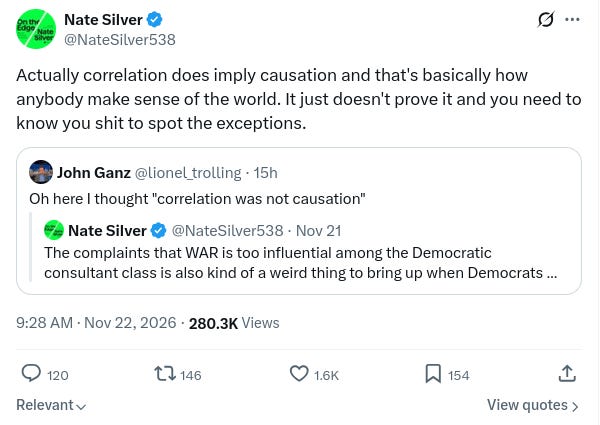
I read a post this weekend on X (née Twitter) from one “Nathan Silver.” It made the rounds, as such posts do, and folks piled on. I think I roughly agree with the spirit of it, though (the spirit of the idea, to be clear, not the standard performative, combative silliness in that thread common among the Internet people):


Okay, first, let’s give the pile-ers their due: read literally, this post is confusing because “imply” and “prove” are effectively the same thing, but I’ll take it seriously, not literally…
The truth-in-the-tweet is that any causal measurement is, ultimately, based on correlations. There isn’t some secret way to measure things “causally.” You have a dataset. There’s a joint distribution of all these variables, and you write down some assumptions that map this distribution into causal effects. However you measure the causal effect, ultimately “correlations” (relationships between variables in the data) determine the effect.
In fact, a great way to understand how causal inference or models identify causality (and whether they make any sense!) is to ask: what correlations in the data determine the effect estimate?
For example:
Standard experiment. Y is the outcome. Z is the binary treatment the experimenter randomly assigned. We assume (Y(0), Y(1)) is independent of Z — which is true because we randomly assigned the treatment. The average treatment effect is ATE = Cov[Y, Z] / Var[Z]; i.e., it depends on the correlation between Y and treatment assignment.
Instrumental variables. Y is the outcome, Z is the treatment, and W is an instrument. We have Y = a + bZ + E, and assume cov[W, E] = 0. So, the causal effect (b) solves cov[W, Y] = b cov[W, Z]. Again, the estimate depends on correlations.
[This is a useful exercise for more “structural modeling” as well, where you identify causality using a detailed model of how the world works, instead of the relatively simple moments above. Sometimes, the moments in the data that identify causality can get a little funny in structural models. It’s a good way to check whether the model identifies the causal effect from restrictions on behavior or from the silly, incidental functional form or separability assumptions often bundled with these models.]
I’m less sassy than Mr. Silver, but correlations are the only way to make sense of the world. We have to add assumptions (our knowledge of the world, our reasoning) to turn those correlations into causal measurements. It’s an interpretation we add to the correlations we observe.
“Correlation does not imply causation” is about a simplistic method of interpreting correlation: if X and Y are correlated, then X caused Y. Clearly, that’s not true. But causal inference is about making assumptions so we can interpret various correlations as causal effects: whether the correlation between random treatment assignment and outcomes, the ratio of covariances of an outcome to an instrument and the treatment to the instrument, or any number of other transformations.
Causality is something we create based on our understanding of the world. The data doesn’t say a thing about it. We do. We argue that W is a valid instrument or that X controls for selection or that firms play a certain game when setting prices.
Causality is fundamentally a deductive exercise. It starts with premises and ends with conclusions. It’s not an inductive process (hypothesis => test the hypothesis) like the statistical analysis we use to measure causal effects. Like all deductive arguments, it starts with a leap of faith.
Revising the tweet:
Correlations measure causation. That’s how we make sense of the world. Not all correlations measure causation. You have to argue which correlations measure causation and why. But, in the end, we measure causation with the data we observe: correlations.
Thanks for reading!
Zach
Connect at: https://linkedin.com/in/zlflynn
Discussion about this post